
- Solutions by Industry
- Solutions by Use Case
- Get Started
Success message
Error message
As enterprises scale across regions, franchises, manufacturing plants, or retail outlets, managing consistent operations across multiple sites becomes a major challenge. A Unified Multi-Site Operations Platform built on Gennexio iPaaS connects distributed sites, edge systems, cloud services, and central systems to deliver synchronized inventory, workforce, compliance, and operational intelligence. The platform supports intermittent connectivity, local autonomy, centralized governance, and real-time analytics to keep distributed operations resilient and efficient.
Modern enterprises face increasing complexity when connecting Workday with diverse business systems.
Fragmented Site Architectures
Multi-site environments rely on heterogeneous POS, PLC, MES, and WMS systems with incompatible vendors and protocols, requiring extensive customization that slows integration efforts and complicates enterprise operations.
Intermittent Connectivity & Edge Constraints
Remote sites experience intermittent networks that require offline-first logic, local buffering, and deterministic reconciliation, creating complexity for synchronization workflows and increasing risk in maintaining consistent enterprise operations.
Inconsistent Operational Policies
Regional regulations, tax rules, labor laws, and site-specific processes require localized exceptions while maintaining centralized governance, creating high complexity for policy enforcement and complicating compliance across enterprise operations.
Lack of Real-time Visibility
Central teams lack unified telemetry for inventory, production, and workforce status across distributed sites, reducing situational awareness, slowing incident response, and complicating timely adjustments in enterprise operations.
High Operational Overhead
Reliance on manual reconciliation, and custom point-to-point integrations increases maintenance cost, slows rollout schedules, and prevents standardized automation, creating ongoing operational friction that complicates broader enterprise operation.
Unified, Low-Code Workday Integration.
Gennexio iPaaS delivers a centralized integration framework that unifies POS, PLC, MES, WMS, and ERP systems across geographically distributed sites. The platform standardizes communication protocols, harmonizes inconsistent data structures, and eliminates custom point-to-point connections, enabling large enterprises to maintain stable, scalable, and repeatable integration patterns across all operational environments.

Use a hybrid synchronization model that blends event-driven CDC (Change Data Capture), pub/sub messaging patterns such as Kafka or MQTT, and scheduled batch synchronization for legacy systems. Deterministic reconciliation rules ensure site-to-site master data coherence, while multi-directional sync pipelines minimize drift and keep operational datasets aligned across geographically distributed environments.

A centralized control plane distributes and enforces global enterprise policies—including pricing governance, regulatory compliance, and access entitlements—while local site agents allow controlled, auditable overrides where operational realities require flexibility. Policy templates, inheritance rules, and role-based enforcement provide strong governance without sacrificing the autonomy needed for site-specific adaptations.
Consolidate telemetry across all sites—including metrics, logs, traces, and integration events—into a centralized observability stack. Automated runbooks and intelligent incident playbooks trigger remediation workflows such as service restarts, traffic failover, queue draining, or ticket generation whenever system thresholds are breached, significantly reducing time-to-recovery across multi-site operations.
A secure API gateway enforces authentication through OAuth2 or OpenID, applies strict per-site tenancy isolation, implements rate-limiting, and encrypts request and response payloads. The accompanying data governance layer handles masking of sensitive fields, automated data-retention enforcement, schema validation, and regional data-residency requirements to maintain compliance across jurisdictions.
CI/CD pipelines combined with containerized site agents—running on Kubernetes or edge-container runtimes—enable predictable, low-risk rollouts across hundreds or thousands of locations. Canary and blue-green deployment strategies reduce downtime, while centralized versioning, dependency management, and one-click rollback capabilities streamline long-term lifecycle operations across distributed sites.
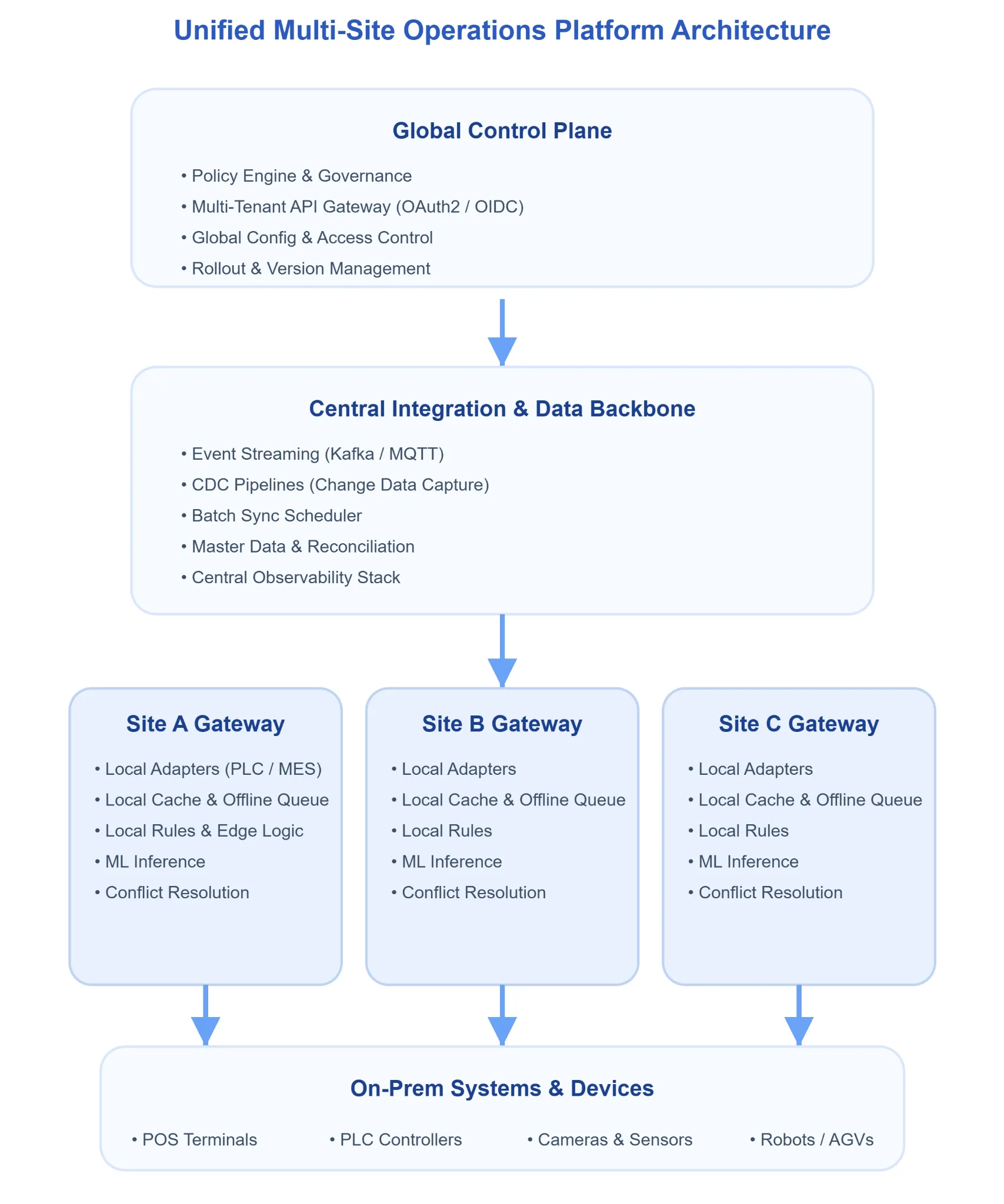
Unified, Low-Code Workday Integration

Achieve Operational Consistency
Unified integration removes silos and synchronizes inventory, pricing, and workforce rules across sites, reducing errors and disputes.

Increase Site Resilience
Edge caching and offline queues ensure critical local operations continue during network outages, improving uptime and customer experience.

Reduce Operational Costs
Replace ad-hoc integrations with reusable connectors, templates, and automated rollouts to lower maintenance and accelerate deployments.

Improve Decision Velocity
Real-time telemetry and aggregated analytics give executives and site managers actionable insights to respond faster to demand and incidents.

Enforce Compliance at Scale
Centralized policy enforcement with per-site configuration ensures regulatory adherence (tax, labor, privacy) while allowing localized compliance variances.

Enable Future Innovation
A modular, API-first architecture accelerates adoption of advanced features (autonomous replenishment, advanced predictive analytics).